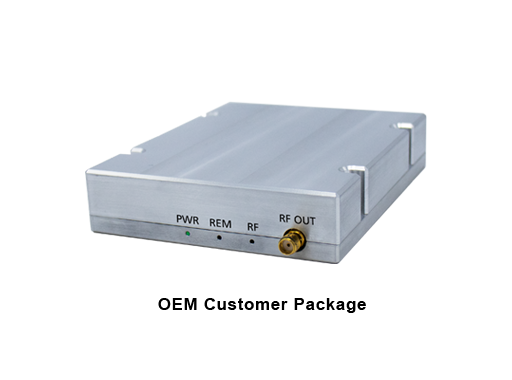
1Overview
The Model 805-M is a compact-size frequency synthesizer for the generation of accurate and stable frequency signal in both CW and pulse form, covering a frequency range of 100 kHz to 22 GHz, with a fast-switching time of 5 µs, the output power of -40 to 25 dBm depending on the frequency. The phase noise at 1 GHz and 20 kHz offset is -132 dBc/Hz, and the subharmonics and spurious lower than -55 dBc. The frequency setting resolution is 10 mHz and for the power 0.5 dB.
The synthesizer is excellently shielded and in a very compact flange-mountable form of 134 x 95 x 25 mm, weighs lighter than 0.5 kg, and consumes barely 17 W and therefore passively cooled. It features ETHERNET communication port for local and remote connection to a PC for control over GUI software or SCPI commands.
The module features external reference support of 100 MHz and 1 GHz. Multiple units can be connected, with one unit acting as the master and the others as slaves, to implement multi-channel phase-coherent sources. The Master reference frequency of 1 GHz is generated once in the master unit and looped through all the slave units. The phase coherence reached is about +/- 0.5 degree over 10 hours when all the channels are set to 5 GHz.
The product is suitable for many applications: as system clock source, in the multi-channel phase-coherent configurations for radar, beamforming, quantum computing, etc. The feature combination of phase coherence and fast switching allows also for applications in Electronic Warfare field.
2Key Features & Applications
Features
- Small size flange-mount module
- CW and pulse modulation
- Low phase noise
- Multi-channel configurable / cascadable: master-slave connection through 1 GHz reference loop-through
- Phase coherent
Applications
- System clock source
- Beamforming, MIMO receiver R&D
- Electronic Warfare
- Multi-channel phase-coherent configurations for radar signal generation and testing
- Spectroscopy
3Signal & Frequency Reference
Signal Specifications
| Parameter | Min | Typical | Max | Note |
|---|---|---|---|---|
| Frequency Range | 100 kHz | 22 GHz | ||
| Resolution | 0.01 Hz | GUI SW setting resolution | ||
| Phase resolution | 0.1 deg | 0 to 360 deg | ||
| Switching speed in sweep mode | 500 µs 5 µs | 10 µs | Option FS |
Frequency Reference
| Parameter | Min | Typical | Max | Note |
|---|---|---|---|---|
| Reference frequency input | 100 MHz, 1 GHz | |||
| Reference input level 100 MHz 1 GHz | -3 dBm -5 dBm | +10 dBm +10 dBm | ||
| Reference input impedance | 50 Ω | |||
| Reference frequency output | ||||
| Power | 2 dBm | 8 dBm | 1 GHz | |
| Calibrated accuracy of int. reference | ±30 ppb | calibrated at 23 ± 3 °C | ||
| Temperature stability (0 to 50 °C) | ±100 ppb | |||
| Aging 1st year | 0.5 ppm | |||
| Aging per day | 5 ppb | After 30 days operation | ||
| Warm-up time | 5 min | |||
| Reference output impedance | 50 Ω | |||
4Level Performance & Uncertainty
Level Performance
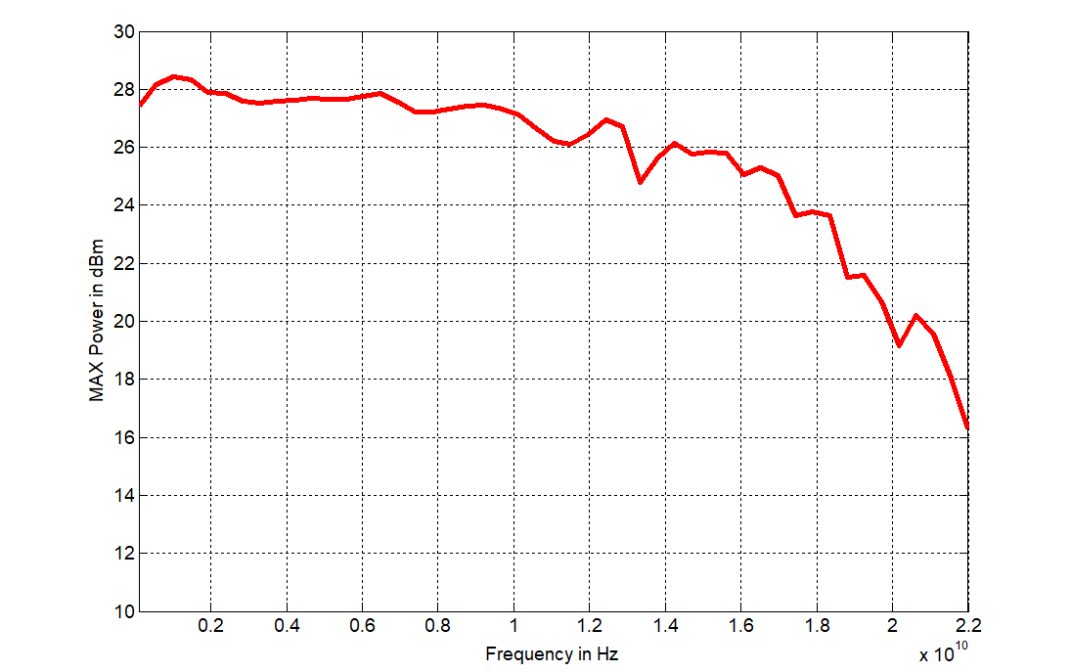
| Parameter | Min | Typical | Max | Note |
|---|---|---|---|---|
| Output Power Level | See plot | |||
| Range 0.1 – 1 GHz 1 – 10 GHz 10 – 18 GHz 18 – 20 GHz > 20 GHz | -20 dBm -30 dBm -20 dBm -30 dBm -30 dBm | +25 dBm +26 dBm +23 dBm +21 dBm +16 dBm | ||
| Resolution | 0.5 dB |
Level Uncertainty
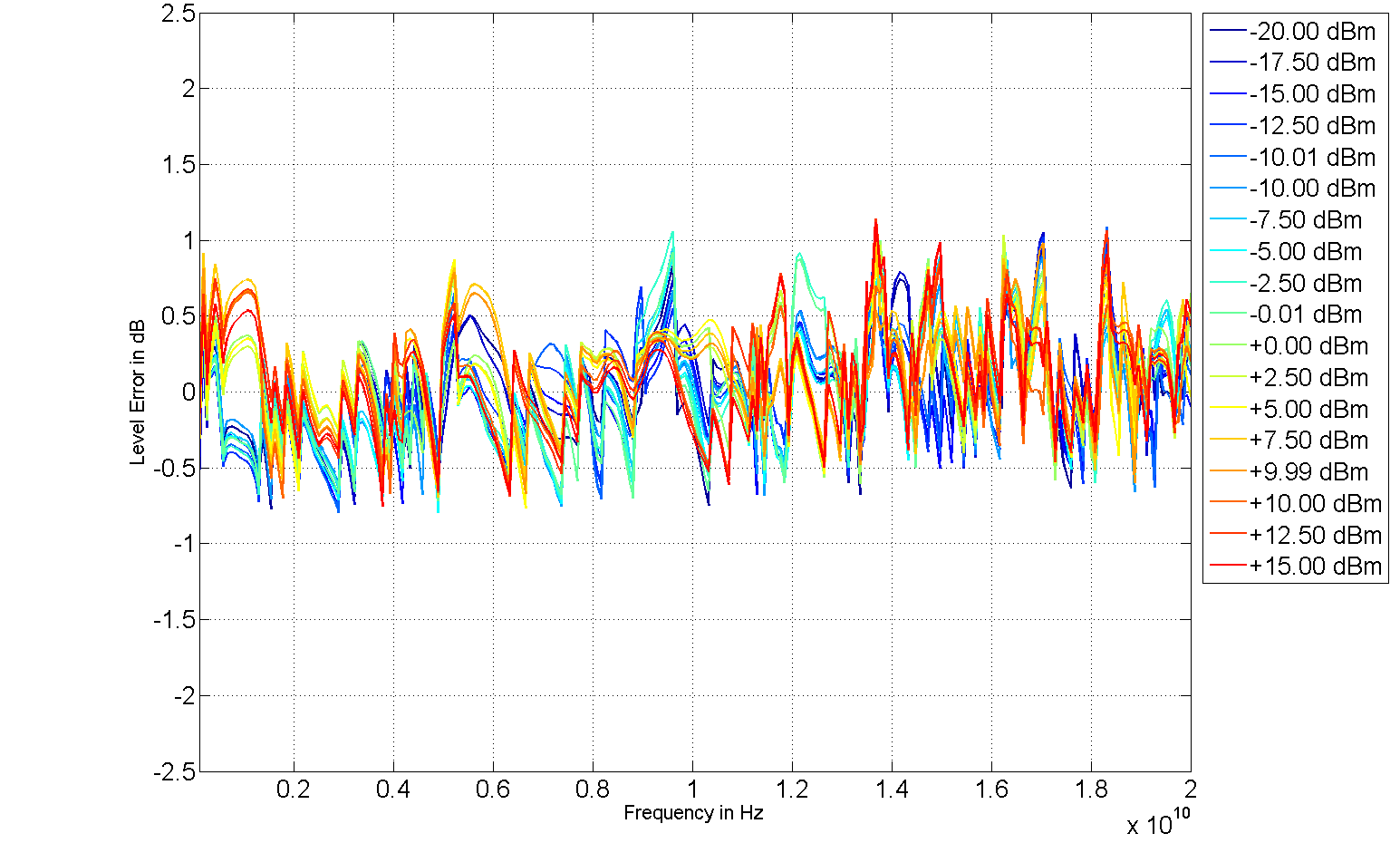
| Parameter | Min | Typical | Max | Note |
|---|---|---|---|---|
| Power Level uncertainty 0.1 GHz to 20 GHz < 0.1 GHz or > 20 GHz | ±1.5 dB ±1.5 dB | ±2 dB | -20 dBm to +20 dBm |
Reverse Power Protection and VSWR
| Parameter | Min | Typical | Max | Note |
|---|---|---|---|---|
| Output impedance | 50 Ω | |||
| VSWR | 1.7 | |||
| Reverse power protection | ||||
| DC voltage | 7 V | |||
| RF power | 23 dBm |
5Phase Noise & Spectral Purity
Phase Noise
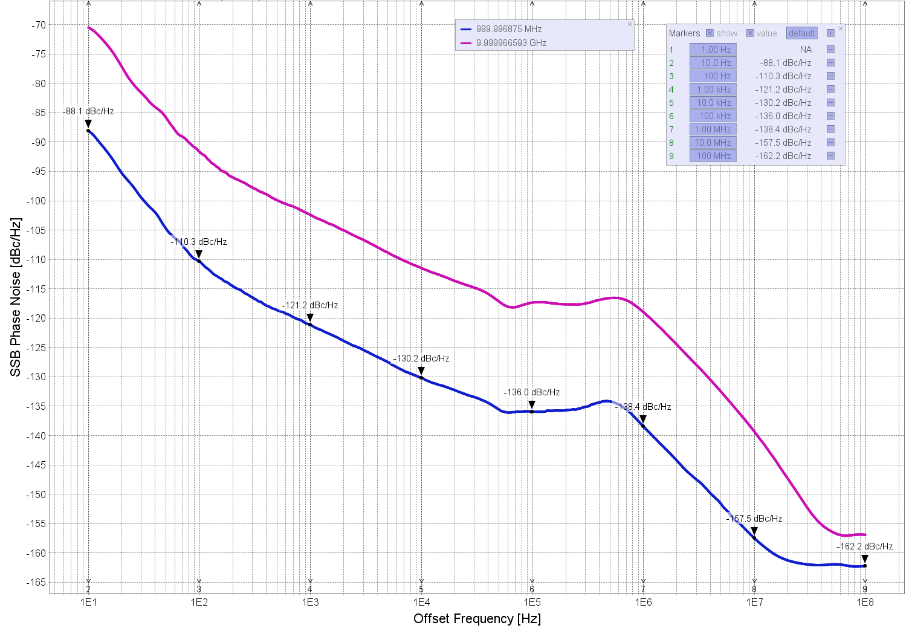
| Parameter | Min | Typical | Max | Note |
|---|---|---|---|---|
| SSB Phase noise at 1 GHz | See also plots | |||
| at 10 Hz from carrier | -83 dBc/Hz | -78 dBc/Hz | ||
| at 1 kHz from carrier | -120 dBc/Hz | -115 dBc/Hz | ||
| at 20 kHz from carrier | -131 dBc/Hz | -126 dBc/Hz | ||
| at 10 MHz from carrier | -154 dBc/Hz | -149 dBc/Hz | ||
| SSB Phase noise at 10 GHz | ||||
| at 10 Hz from carrier | -70 dBc/Hz | -65 dBc/Hz | ||
| at 1 kHz from carrier | -102 dBc/Hz | -98 dBc/Hz | ||
| at 20 kHz from carrier | -112 dBc/Hz | -107 dBc/Hz | ||
| at 10 MHz from carrier | -140 dBc/Hz | -135 dBc/Hz |
Spectral Purity
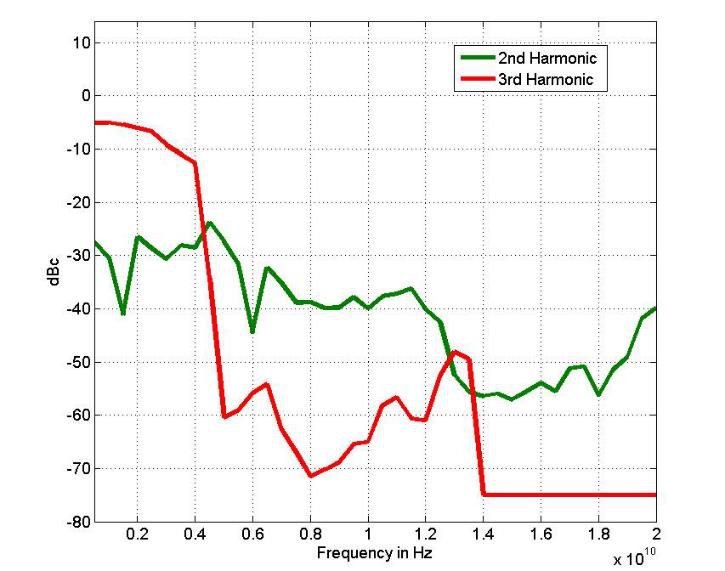
| Parameter | Min | Typical | Max | Note |
|---|---|---|---|---|
| Output harmonics < 4.0 GHz 4.0 – 14 GHz > 14.0 GHz | -15 dBc -27 dBc -60 dBc | -5 dBc -20 dBc -40 dBc | Pout = 10 dBm | |
| Sub-harmonics < 11.0 GHz 11.0 – 20.0 GHz > 20.0 GHz | -80 dBc -70 dBc -65 dBc | -70 dBc -60 dBc | Pout = 10 dBm | |
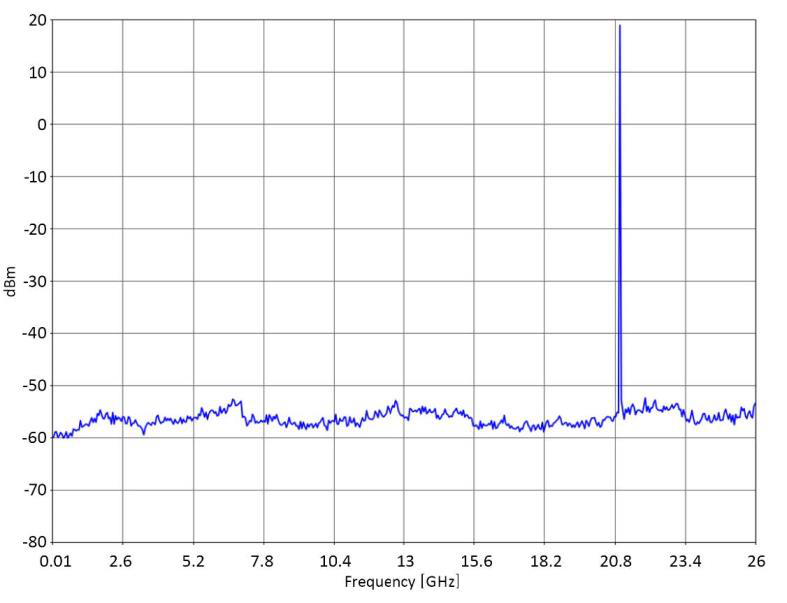
| Non-harmonic spurious | -65 dBc | -55 dBc | > 10 kHz offset |
6Modulation
Modulation Capability
| Parameter | Min | Typical | Max | Note |
|---|---|---|---|---|
| Pulse modulation | ||||
| Modulation source | Internal, External | Trigger port can be reconfigured as external modulation port | ||
| On/off ratio < 1 GHz 1 GHz to 10 GHz 10 GHz to 19 GHz > 19 GHz | 75 dB 60 dB 55 dB 50 dB | 85 dB 70 dB 65 dB 60 dB | At 10 dBm | |
| Repetition frequency | DC | 10 MHz | ||
| Pulse width | 30 ns | 20 s | ||
| Pulse rise/fall time | 9 ns | |||
| Pulse train length (pulses) | 1 | 4096 | ||
| External input voltage range | -0.5 V | +5.5 V | TTL compatible | |
| External input hysteresis | 60 mV | |||
| Delay (to RF) | 20 ns | 40 ns | ||
7Sweeping & Trigger
Sweeping Capability
| Parameter | Min | Typical | Max | Note |
|---|---|---|---|---|
| Sweep parameters | Frequency, power, list | |||
| Sweep type | Linear, logarithmic, random | |||
| Step time | 500 µs 5 µs | 20 s 20 s | Option FS | |
| Timing resolution | 10 ns | |||
| Timing accuracy per point | 20 ns | |||
| Generalized list sweep | Allows for individual setting of frequency, power, step-time, for each point | |||
Trigger (TRIG)
| Parameter | Min | Typical | Max | Note |
|---|---|---|---|---|
| Trigger types | Continuous, Single (point), Gated, Gated direction | |||
| Trigger source | External | |||
| Trigger modes | Continuous free run, Trigger and run, Reset and run | |||
| External trigger latency | 140 ns | |||
| External trigger uncertainty | 20 ns | |||
| External trigger delay | 0 s | 20 s | Settable | |
| External delay resolution | 10 ns | |||
| Trigger modulo | 1 | 255 | Execute only on Nth trigger event | |
| Trigger polarity | Rising | Falling | ||
| External trigger input threshold | 0.85 V | 0.9 V | 0.95 V | TTL compatible |
| External trigger input voltage range | -0.5 V | +5.5 V | TTL compatible | |
| External trigger input hysteresis | 60 mV | |||
8Mechanical & Connectors
Dimensions & Weight
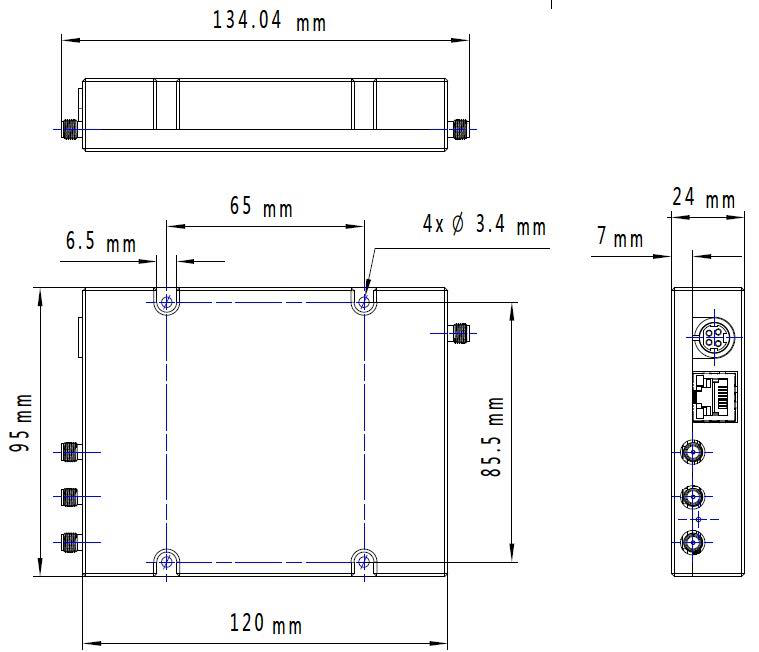
| Dimensions / Weight | Including Connectors |
|---|---|
| Size / Weight | 5.28 x 3.74 x 1.00 in [134 x 95 x 24 mm] / 1.0 lbs [0.45 kg] |
Installation Instructions
The module relies on passive cooling. It is mandatory to mount the device on a heatsinking surface. Make sure the synthesizer operates under the conditions specified in this datasheet. Otherwise, the thermal protection will turn off the RF output.
Connectors
Front Panel
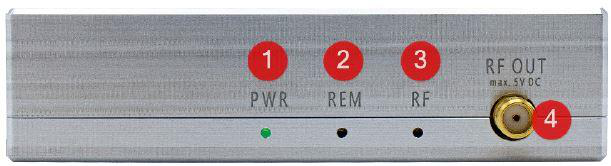
| Label | Type | Description |
|---|---|---|
| 1. PWR | LED | Power ON/OFF indicator |
| 2. REM | LED | Remote connection status indicator |
| 3. RF | LED | RF output ON/OFF indicator |
| 4. RF OUT | SMA | RF output |
Rear Panel
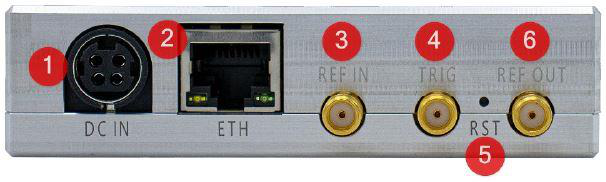
| Label | Type | Description |
|---|---|---|
| 1. DC IN | KPJX-4S (Kycon) | DC input (see also “Power Connector Assembly”) |
| 2. ETH | RJ-45 | Ethernet port |
| 3. REF IN | SMA | Reference Signal Input |
| 4. TRIG | SMA | Trigger Signal Input |
| 5. RST | Button | Reset Button |
| 6. REF OUT | SMA | Reference Signal output |
Power Connector Assembly
| Pin | Assignment |
|---|---|
| 1 | GND |
| 2 | DC Supply (see also “Power requirements”) |
| 3 | GND |
| 4 | DC Supply (see also “Power requirements”) |
The power connector is a 4 pin, snap and look receptacle. BNC recommends Kycon manufactured plugs KPPX-4P from its KPPX series.
Reset Functionality
The reset functionality of the device can be used if the device has a wrong configured IP address and cannot be found in the local area network anymore. While pressing the reset button (>2 s), the device will be reconfigured to auto IP addressing mode (DHCP/Zero-conf) and restarts itself. After the device is up and running again, it gets a new IP address and can be discovered by the BNC Signal Generator UI.
9General Characteristics
| Parameter | Specification |
|---|---|
| Remote Programming Interfaces | Ethernet |
| Control language | SCPI Version 1999.0 |
| Power requirements | 24±6 VDC; 17 W maximum |
| Mains adapter supplied | 100-240 VAC in / 24 V, 2.7 A DC out |
| Storage temperature range | –40 to 70 °C |
| Operating temperature range | 0 to 45 °C; non-condensing |
| Operating and storage altitude | up to 15,000 feet |
| Safety/EMC | complies with applicable Safety and EMC regulations and directives |
| Recommended calibration cycle | 24 months |
10Ordering Information
| Host Model | Product | Description |
|---|---|---|
| 805-M | 805-M | 22 GHz wideband frequency synthesizer module |
| 805-M | Option FS | Fast switching option |
| 805-M | Option NOXO | No internal reference |
To request a quote, contact Berkeley Nucleonics Corporation · info@berkeleynucleonics.com · 415-453-9955 · berkeleynucleonics.com