1Overview
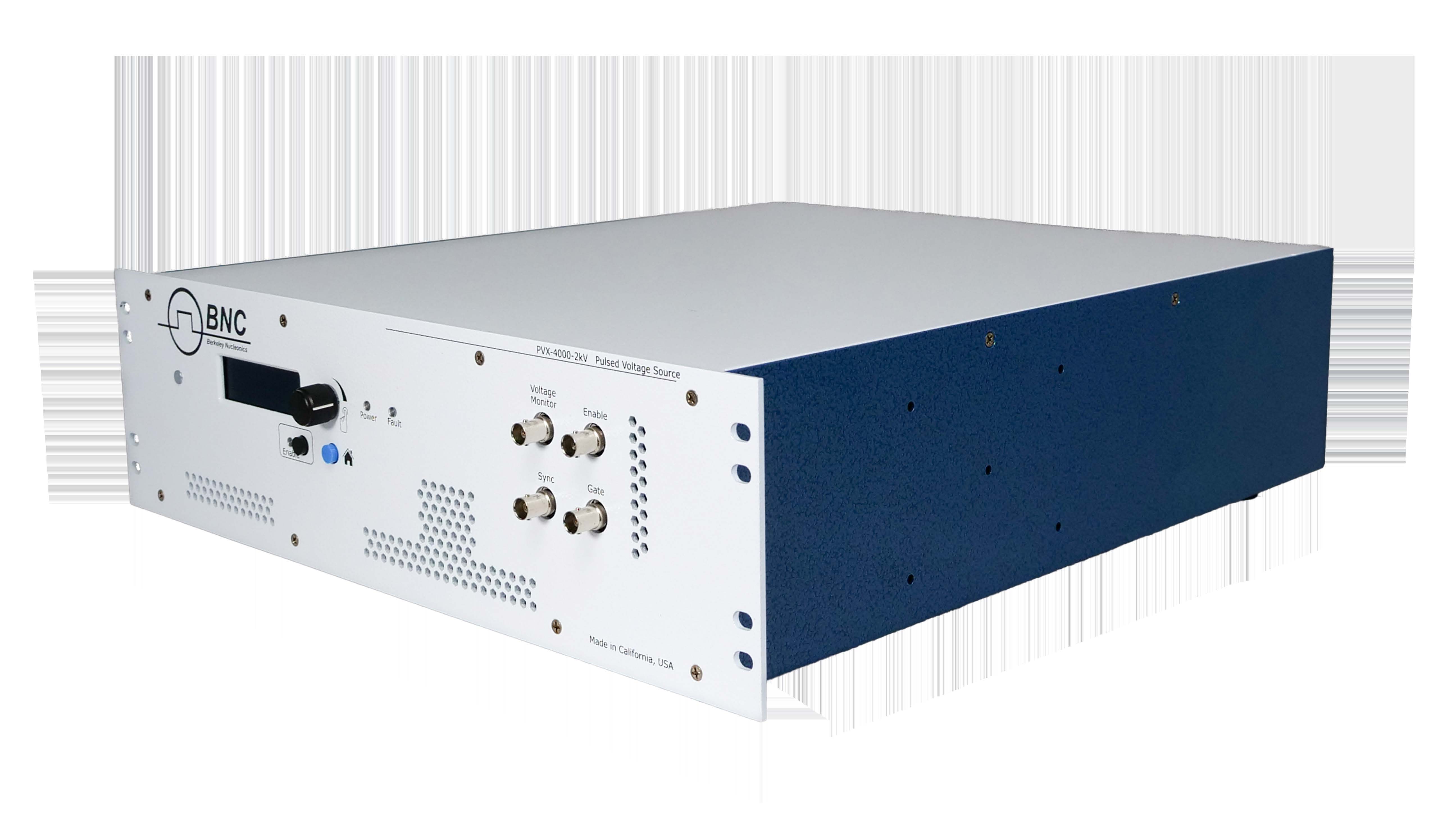
The PVX-4000-2kV is an air-cooled high-voltage pulse generator built to drive high-impedance capacitive loads. It produces fast bipolar pulses up to plus or minus 2000 V, with the positive and negative excursions sharing a 2000 V budget. The output is designed for extraction grids, deflection plates, and similar electrostatic elements, where the load looks capacitive and the pulse must rise and settle quickly without excessive overshoot.
The standard PVX-4000-2kV carries internal positive and negative HV DC power supplies, so it runs as a complete standalone test system out of the box. A PVX-4000-2kV-EX variant that accepts external HV supplies is part of the PVX-4000 series; its specific ratings are not covered by the source datasheet for this page and are flagged for verification where they appear.
The PVX-4000-2kV provides the same plus or minus 2000 V range, fast and clean rise and fall behavior, and a front-panel plus RS-232 and USB control and monitoring interface. Up to five system configurations can be stored in non-volatile memory and recalled, which makes repeated test setups quick to reproduce. DEI, now a division of Berkeley Nucleonics, originated this pulse-generator line.
2How It Works
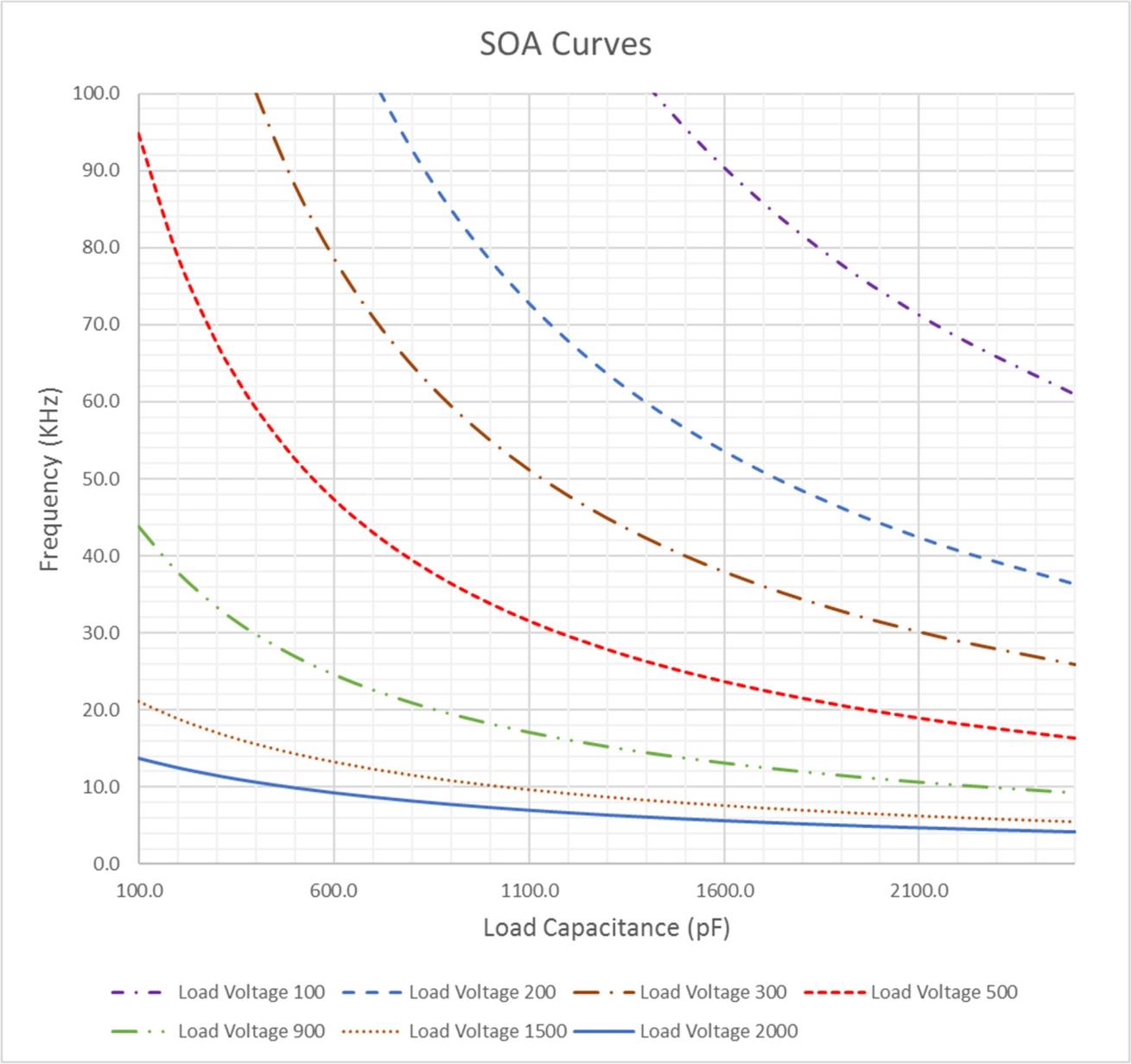
The PVX-4000 switches a high-voltage output between programmed positive and negative levels, charging and discharging the capacitive load on each transition. Because the load is capacitive, the achievable repetition rate depends on how much charge the output stage must move per pulse, which in turn depends on the load capacitance and the voltage swing. The Safe Operating Area (SOA) curves capture this relationship directly.
Output can be driven from the internal trigger generator or from an external gate. The internal trigger covers 40 Hz to 30 kHz. The external gate accepts external gating from single-shot up to 100 kHz. The EX variant's external-gate ceiling is not stated in the source datasheet for this page and is flagged for verification.
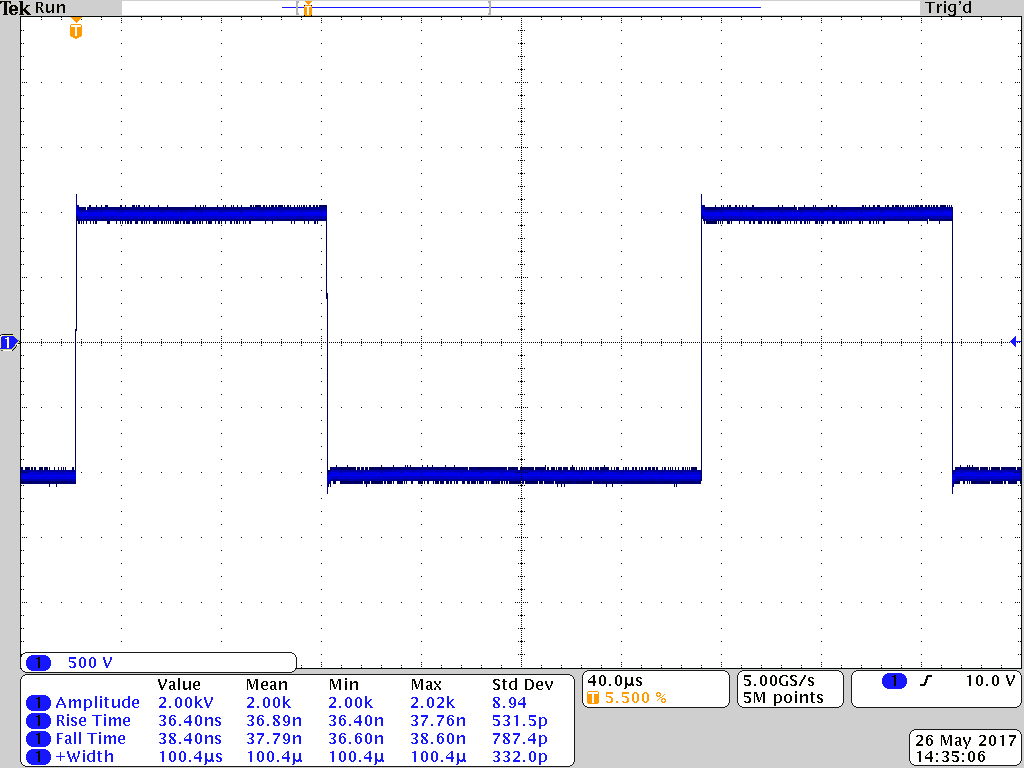
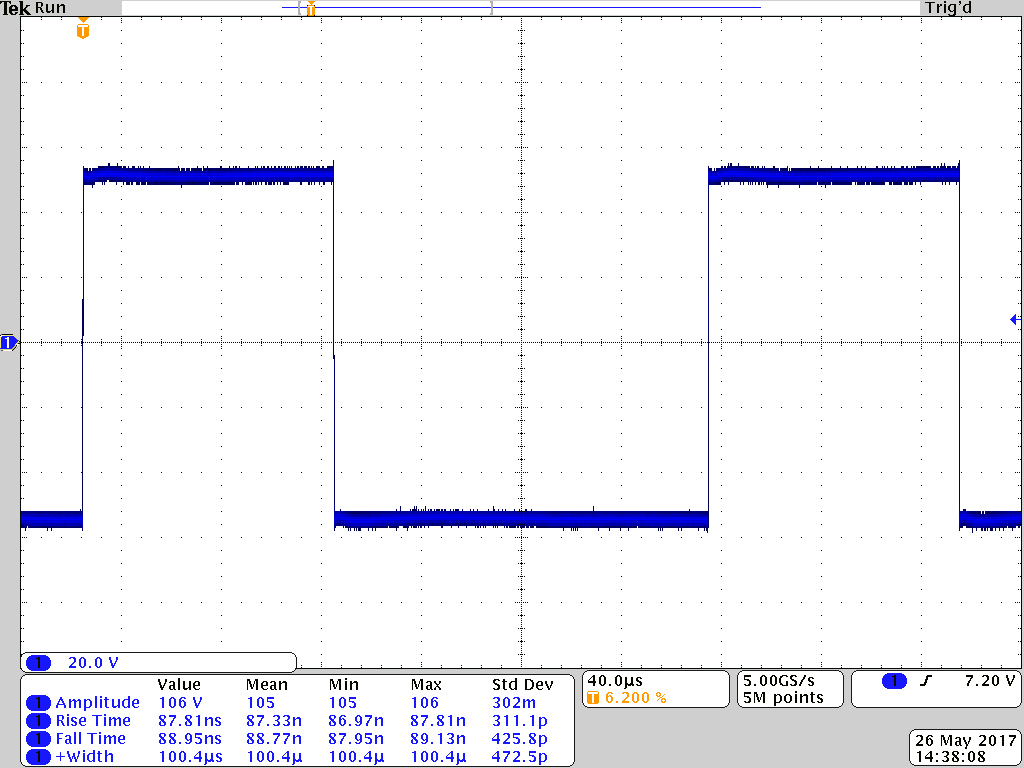
The external gate input is a simple logic-level control: 0 V holds the output off, and plus 5 V turns the output on. With the gate held continuously, duty cycle can reach 100 percent. Pulse shape is fast and clean, with rise and fall times at or below 50 ns over the 500 V to 2000 V span and overshoot held under 2 percent.
3Specifications
All specifications are preliminary and subject to verification against the published Berkeley Nucleonics datasheet. The table below compares the two variants. Where a value is shared, it applies to both.
| Parameter | PVX-4000-2kV | PVX-4000-2kV-EX |
|---|---|---|
| Configuration | Standalone; internal positive and negative HV DC supplies | Accepts external HV supplies (variant not detailed in source datasheet; verify) |
| Cooling | Air-cooled | Air-cooled |
| Output voltage range | 0 V to ±2000 V1 | 0 V to ±2000 V1 |
| Voltage overshoot | < 2% | < 2% |
| Rise / fall time (500 V to 2000 V)2 | ≤ 50 ns | ≤ 50 ns |
| Rise / fall time (200 V to 500 V)2 | ≤ 100 ns | ≤ 100 ns |
| Internal trigger frequency range | 40 Hz to 30 kHz | 40 Hz to 30 kHz |
| Internal trigger frequency resolution | 10 Hz (40 Hz to 1000 Hz); 100 Hz (1100 Hz to 30 kHz) | 10 Hz (40 Hz to 1000 Hz); 100 Hz (1100 Hz to 30 kHz) |
| Internal trigger pulse width | 2% to 98% duty cycle | 2% to 98% duty cycle |
| Internal pulse width resolution | 6.4 µs (40 Hz–1000 Hz); 0.4 µs (1100–5000 Hz); 0.05 µs (5100–30000 Hz) | 6.4 µs (40 Hz–1000 Hz); 0.4 µs (1100–5000 Hz); 0.05 µs (5100–30000 Hz) |
| External gate frequency range | Single-shot to 100 kHz | Single-shot to 100 kHz (verify EX rating) |
| External gate trigger pulse width | 500 ns to 100% duty cycle | 500 ns to 100% duty cycle |
| External gate input | BNC, 50 Ω termination; 0 V = output off, +5 V = output on | BNC, 50 Ω termination; 0 V = output off, +5 V = output on |
| Voltage monitor | 1000 V / 10 V typical, 1 MΩ termination, BNC3 | 1000 V / 10 V typical, 1 MΩ termination, BNC3 |
| Sync output | 50 Ω, BNC; 0 V out = −HV output pulse; < +3.3 V out = +HV output pulse | 50 Ω, BNC; 0 V out = −HV output pulse; < +3.3 V out = +HV output pulse |
| Enable input | BNC; external dry-contact closure or factory-supplied shorting BNC plug | BNC; external dry-contact closure or factory-supplied shorting BNC plug |
| Pulsed output connector | Winchester Kings 10 kV, rear panel, 1065-2 plug | Winchester Kings 10 kV, rear panel, 1065-2 plug |
| DC HV input connectors | Not applicable (internal supplies) | External HV input (verify connector) |
| Output power | Refer to the SOA curves | Refer to the SOA curves |
| Input power | 100–120 VAC ±10% / 220–240 VAC ±10%, 50–60 Hz | 100–120 VAC ±10% / 220–240 VAC ±10%, 50–60 Hz |
| Power consumption | 600 W | (verify EX rating) |
| AC connector | NEMA C-14 | NEMA C-14 |
| Computer communication | RS-232 and USB, 115200 baud, 8 data bits, no parity, 1 stop bit, no flow control | RS-232 and USB, 115200 baud, 8 data bits, no parity, 1 stop bit, no flow control |
| Stored configurations | Up to five, in non-volatile memory | Up to five, in non-volatile memory |
| Size (H x W x D) | 15 cm x 49 cm x 52 cm | 15 cm x 49 cm x 52 cm |
| Weight | 8 kg | (verify EX rating) |
| Operating temperature | 15 °C to 35 °C | 15 °C to 35 °C |
Safe Operating Area
The Safe Operating Area defines the usable envelope for this pulse generator. For each output voltage, the curve sets the maximum pulse repetition frequency as a function of load capacitance. Stay below the relevant curve to keep the output stage within its thermal and current limits. Remember to add the cable contribution, 1.57 pF per 1.0 cm, to the bare load capacitance before reading the chart.
4Monitoring & Front Panel
The front panel groups the controls and the diagnostic signals needed to set up and verify pulse operation. Trigger source, voltage levels, and gate behavior are configured locally or over the computer interface, and two BNC outputs let an oscilloscope confirm what the generator is doing.
Voltage Monitor
The voltage monitor scales the high-voltage output to a safe, scope-friendly level at 1000 V per 10 V, typical, into a 1 MΩ termination on a BNC. Connect it with RG-58/U 2 ft coax into a 1 MΩ oscilloscope input. This gives a real-time view of the output pulse amplitude and shape without direct contact with the high-voltage line.
Sync Output
The sync output is a 50 Ω BNC that flags output polarity for the scope and downstream timing. A 0 V sync level corresponds to a negative HV output pulse, and a sync level below plus 3.3 V corresponds to a positive HV output pulse. Use it to trigger acquisition in step with the pulse train.
Enable Input
The enable input is a BNC that arms the output. It accepts an external dry-contact closure, or the factory-supplied shorting BNC plug for benchtop use. With the enable open, the output stays inhibited, which supports a simple external interlock.
Computer Communication
Both variants communicate over RS-232 and USB at 115200 baud, 8 data bits, no parity, 1 stop bit, and no flow control. Up to five complete system configurations can be stored in non-volatile memory and recalled, so repeated experiments and production tests return to a known state quickly.
5Applications
The PVX-4000-2kV and PVX-4000-2kV-EX are purpose-built for electrostatic modulation of charged-particle beams, where the load is a grid or a plate that behaves as a capacitor and the timing must be precise.
- Time-of-flight mass spectrometry. Drive extraction grids and pulsing electrodes to inject and gate ion packets, where fast, repeatable transitions set mass resolution.
- Accelerator beam steering and gating. Apply pulsed potentials to deflection plates for beam blanking, chopping, and electrostatic steering.
- Ion and electron optics. Switch extraction and lens elements that present a capacitive load and require clean, bounded-overshoot edges.
- Pulsed electrostatic deflection. Deflect or deflect-and-blank a beam at internal rates to 30 kHz, or under external gate to 100 kHz.
Choosing between the two variants
Pick the standard PVX-4000-2kV when a self-contained system is the priority. Its internal positive and negative HV supplies make it a complete bench instrument with nothing else to source, drawing 600 W from the wall. The PVX-4000-2kV-EX accepts external HV supplies instead of carrying its own; its repetition-rate and power ratings are not specified in the source datasheet for this page and should be confirmed with Berkeley Nucleonics before selection.
6Ordering Information
| Model / Part | Description |
|---|---|
| PVX-4000-2kV | System (standalone, with internal HV supplies) |
| PCA-9400 | Output Cable |
| PCA-9410 | BNC Shorting Connector |
| PVX-4000-2kV-EX | External-HV-supply variant (part number and contents not listed in source datasheet; verify) |
Contact
For a quote, a configuration matched to your beamline or spectrometer, or application support, reach the Berkeley Nucleonics team.
Email: info@berkeleynucleonics.com
Phone: 800-234-7858